Marc-Antoine Charpentier: In nativitatem Domini Nostri Jesu Christi canticum H.414 (1684)
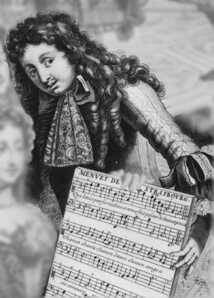
‘Monsieur Charpentier’ from Pierre Landry's Almanach Royale (1682);
presumably Marc-Antoine Charpentier
Marc-Antoine Charpentier
born around 1643 in Paris,
died 24 February 1704 in Paris
Composition
1684 for Marie de Lorraine, Duchess of Guise and cousin of King Louis XIV, who maintained a small ensemble of singers and instrumentalists at her hotel, which Charpentier directed until the princess's death in 1688.
CD recordings:
Aradia Ensemble, Kevin Mallon 1999
William Christie and Les Arts Florissants 2011
More than 200 motets by Marc-Antoine Charpentier have been preserved, which were sung during church services and, depending on their dramatic content, also performed scenically.
During his three-year stay in Rome, he was particularly influenced by the oratorios of his teacher at the Collegium Germanicum, Giacomo Carissimi (1605–1674). Sacred works of this kind did not yet exist in France at that time. Charpentier did not use the term oratorio either, which is why today we tend to refer to them as historiae sacrae. Charpentier called his pastoral Christmas oratorios Canticum.
No other composer has made such a diverse contribution to Christmas celebrations as Charpentier. Particularly noteworthy are: Canticum in nativitatem Domini H.393 (1670), In Nativitatem D. N. J. C. Canticum H.414 (1683–1685), In nativitatem Domini canticum H.416 (1680), In nativitate Domini Nostri Jesu Christi canticum H.421 (1698–99), Dialogus inter angelos et pastores Judeae in nativitatem Domini H.420 (1690). Noël sur les instruments H.534 (1690) and the Messe de minuit pour Noël (1694).
For me, one of the most appealing of Charpentier's Christmas compositions is In nativitatem Domini Nostri Jesu Christi canticum H 414. The work beautifully highlights its pastoral character. In addition to its brevity and focus on the shepherds' journey, it captivates formally with nine alternating, different movements: 1) Prelude (instrumental), 2) Recitative, 3) Aria, 4) Chorus, 5) March (instrumental), and again 6) Recitative, 7) Aria, 8) Chorus and 9) Final (instrumental). Three performing ‘interlocutors’ appear: a historicus, who sings the narrator's part alone or in a group, an angel and the shepherds. Charpentier's works are characterised by naturalness and, at the same time, solemn seriousness. Canticum H.414 is characterised by simple naturalness and the solemnity of its portrayal of a simple, popular Christmas faith, as promoted in the post-Reformation period by believers such as the dedicatee Marie de Lorraine, Duchess of Guise, and the Catholic Church in France.
The structure of Canticum H 414 is symmetrical, as is often the case in Charpentier's works. In the middle, an instrumental piece in the form of a march is heard, depicting the scene of the journey to the manger in Bethlehem as a succession, which could probably also be easily understood scenically. The deeper meaning of the musical simplicity is not some kind of pastoral romanticism or Christmas spirit, but a call to seek and follow Jesus. Even at Christmas, we must not forget Jesus' boundary-crossing work, deeds and teachings, which ultimately cost him his young life. Unfortunately, what made this itinerant preacher Yeshua of Nazareth so special is often hidden in religious celebrations behind folk rituals and Christological titles and dogmas. But even in the non-biographical childhood stories, the evangelist and theologian Luke pointed out that even in Bethlehem, Jesus – as the hoped-for new King David – had first turned to the poor and those living in darkness, in order to give them a place of honour and equality in the community.
‘In nativitatem Domini Nostri Jesu Christi canticum’ H. 414 was written in 1684 for Marie de Lorraine, Duchess of Guise and cousin of King Louis XIV, who entertained a small ensemble of singers and instrumentalists in her hotel, which Charpentier directed until the princess's death in 1688. He was then employed by the Jesuits as maître de la musique at the Church of Saint-Paul-Saint-Louis. Charpentier died in poverty in Paris in 1704.
Listen here (approx. 16 min.)