Toru Takemitsu
Born 8 October 1930 in Tokyo, Japan
Died 20 February 1996 in Tokyo, Japan
Premiere:
20 June 1957 by the Tokyo Symphony Orchestra, conducted by Hitoshi Ueda
CD recordings (among others):
1991 Saito Kinen Orchestra, conducted by Seiji Ozawa
1991 Tokyo Metropolitan Symphony Orchestra, conducted by Hiroshi Wakasugi
2020 NHK Symphony Orchestra, conducted by Paavo Järvi
The experience of the death of a loved one or the awareness of the inevitability of one's own death are existential questions that lie at the heart of religious inquiry.
The Japanese composer Toru Takemitsu experienced both at a young age. One of his important colleagues and teachers, Fumio Hayasaka, who became famous for his music for Akira Kurosawa's classic films ‘Rashomon’ and ‘Seven Samurai’, died in 1955 at the age of 41. Takemitsu himself was in hospital at the time with tuberculosis. He later commented on this:
‘I was particularly ill at the time, and when I finally realised that I didn't know when I myself would die, I ended up thinking that I wanted to create something before my death, one way or another... I thought I should write my own requiem.’
He also saw his own bitter memories of the war captured in his Requiem:
‘I called it “Requiem”... we were robbed of our people in the war – not just the Japanese, our world. I think music must be a form of prayer.’
In an introduction to the work, Yoshi Takemitsu commented on the philosophical and spiritual content of Requiem:
"The concept of “metre” in this work is completely different from that generally used in Western music. The work is based on a rhythm that could be described as “one to one”. There is no clear beginning and no clear end. I have merely extracted a part of the continuum of sounds that flows like an undercurrent beneath humanity and its universe. That is how I would describe the essential character of the work. ‘Meditation’ would have been an equally appropriate title for the ‘Requiem’. Meditation implies exclusive concentration on God, and similarly, this choice of title was motivated by the desire to focus the mind on a single object."
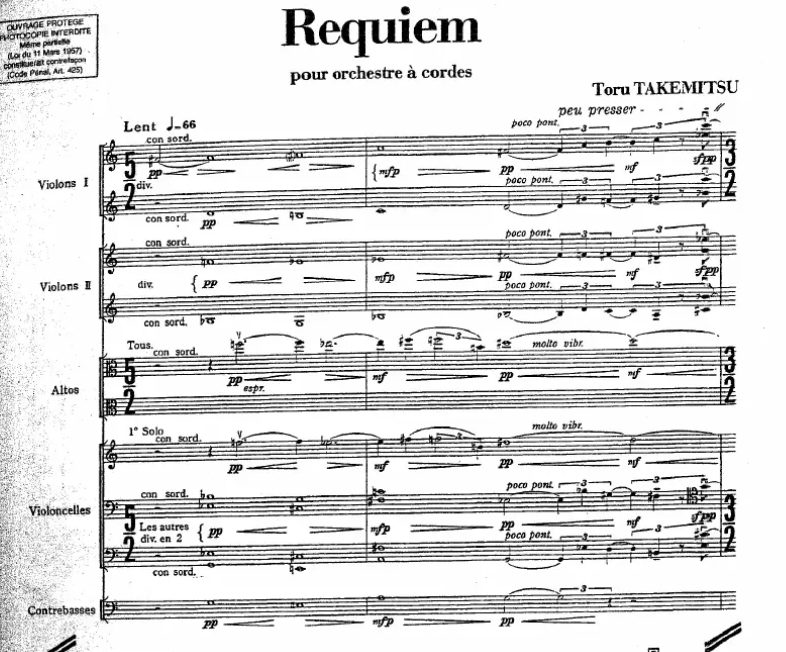
Toru Takemitsu's Requiem is one of the most frequently performed pieces of music of the 20th century in Japan. When Igor Stravinsky visited Japan in 1958/59, he happened to hear a radio recording of ‘Requiem’ and called it a masterpiece, which subsequently helped the young composer Takemitsu achieve worldwide recognition. The score for the Requiem calls for a divided string orchestra, i.e. two groups of first violins, two of second violins, two of violas, two of cellos and double basses.
Listen here! (approx. 9 min.)