Josquin Desprez: Motet “Ave Maria … Virgo Serena” (c. 1485)
Josquin Desprez, also known as Josquin des Préz, Jossequin Lebloitte, Jossequin Lebloitte dit Desprez, or Josquinus Pratensis
Born around 1450 in the vicinity of Saint Quentin,
died August 27, 1521, in Condé-sur-l'Escaut, France
Composed:
around 1485 in Milan, printed in 1502
Numerous recordings:
including
1984 The Hillard Ensemble
2021 VOCES8
The motet “Ave Maria ... Virgo Serena” by Josquin Deprez is one of the best-known motets of the second generation of Renaissance composers. It is widely recognized as a masterpiece in terms of polyphony, complex vocal lines, and a deep understanding of the text. It has been examined thoroughly from a music history and music analysis perspective, even though researchers are still unsure whether it was actually composed in Milan around 1485 or later, after Josquin's return to northern France. Not much is known about Josquin's life, except that he was already a famous composer among connoisseurs at that time. In any case, the Venetian music printer and publisher Ottaviano Petrucci (1466–1539) placed this motet by Josquin Deprez at the beginning of his collection of motets, obviously aware of its own magic. The audience of that time certainly did not have access to these motet compositions through printed music, analysis, or historical research. Rather, the great Gothic and Renaissance church buildings played a mediating role, for nothing filled these spaces more beautifully than the singing of these new, artful, polyphonic sound experiments. Listening directly to the vocal lines and feeling the harmonies from cadence to cadence was probably what made these songs, which emerged during the Renaissance, so fascinating.
Nevertheless, it is no coincidence that it was precisely Marian devotion that prompted composers and liturgists of the late Middle Ages to incorporate these songs into their church services. The symbolic figure of Mary and her images, festivals, and songs opened up new avenues to religion for the people of that time. The motet “Ave Maria ... Virgo Serena” in particular is an example of profound catechesis that sought to open up the religious mystery of human existence to late medieval piety.
In order to understand the spiritual dimension of this composition in terms of both text and melody, both intellectually and emotionally, we need to find a new approach today. Devotion to Mary is probably only still genuine among a small group of more traditional people. Therefore, the symbolism of the hymn “Ave Maria ... Virgo Serena,” a prayer poem originally rooted in the tradition of Gregorian chant, must be reinterpreted. The “Mary” greeted in this prayer is a key figure in the communication of essential religious human experiences. She symbolically refers to holistic, emotion-triggering acts, such as how the spiritual, life in life, can be positively experienced and celebrated. Thus, the middle five stanzas of this hymn refer to origin (“concerptio”), birth (“nativitas”), autonomy (“sine viro fecunditas”), dignity (‘virginitas’), and the ultimate destiny of human existence (“assumptio”). All these fundamental acts of human existence are placed in the context of an unconditional involvement with a hidden ultimate reality (“Dominus tecum”), as explicitly indicated at the beginning and end of this prayer poem. This symbolically profound basic content also allows us to hear the composition of this motet in a new light.
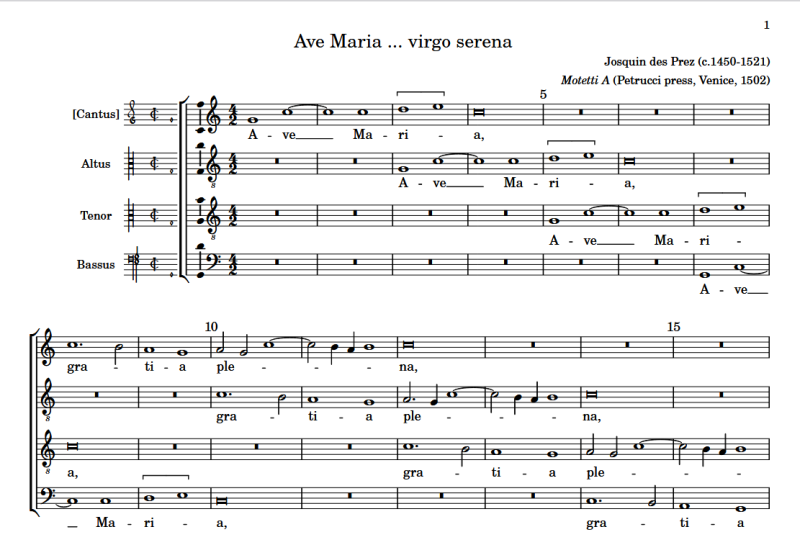
The motet “Ave Maria ... Virgo Serena” is a four-part piece, originally composed for four male voices: a superius (cantus), an altus, a tenor, and a bass.
Listen here! (approx. 6 min.)
Listening companion
Exordium (introduction)
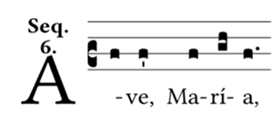
After a short upbeat, the leading first voice (superius) takes up the melody of the ancient Gregorian chant: