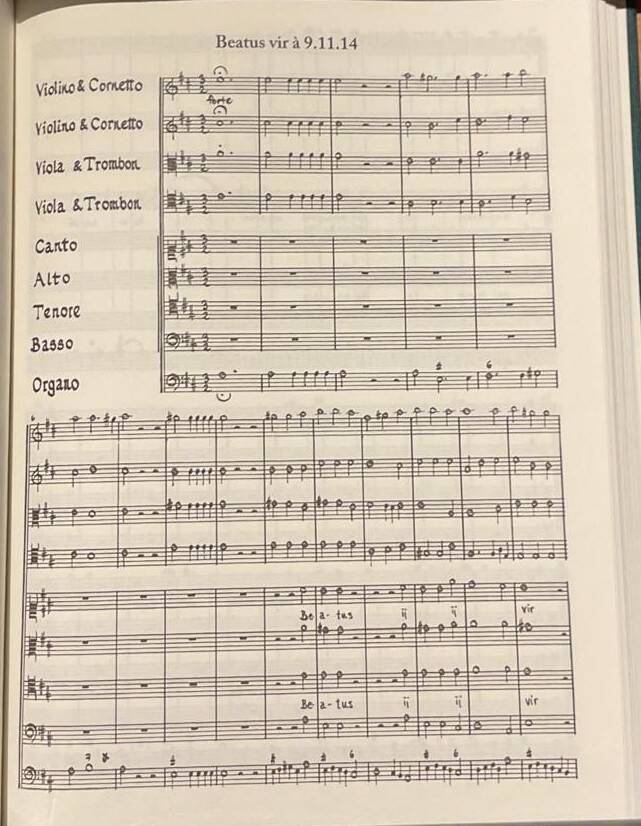
In the style of a Venetian opera symphony, the entrada begins with a five-part instrumental ensemble (the strings are reinforced by two cornetti and two tromboni). A repeating motif immediately catches the ear. Three times, the vocal ensemble interjects with its chordal ‘Beatus vir’ interjections. Then the cantus (the upper voice) sings the first verse with a broad melodic sweep. The repetitive motif appears after the text ‘in mandatis ejus’ (‘in his commandments’) and expresses the joy of the moral subject, who feels grounded in truthfulness and God. Once again, the interjections ‘Beatus vir’ follow in confirmation. The alto repeats the opening verse and the melody of the cantus. At the end of the rhetorical opening section, the exordium, as classical rhetoric teaches, the repetition motif and the joy remain.
The narratio now begins by recounting the consequences of fear of God and lived self-determination: power, honour, wealth and justice, all of which were certainly welcome at the princely courts of the Baroque period.
A battle cry motif to ‘potens’ is confidently divided between the orchestra and the voices (a bass solo, then a tenor/bass duet) and rhythmically passed on to all future generations.
The new motif introduced in stilo concitato on ‘gloria’ also alternates between instruments and vocal ensemble. A fugato of voices then leads from the divites (riches) to a broad motif descending from above on et iustitia, clearly emphasising this enduring (manet!) principle of basic distribution at the conclusion of this section.
Like a small concerto grosso with two solo violins as concertino, an instrumental interlude is inserted before the bass sings of the radiance of light in a similarly concertante style. In a series of bold harmonic blocks, the entire ensemble depicts the various characteristics of the righteous man, radiating mercy.
A ritornello played by the instruments in 3/2 time introduces an arioso section, rhetorically the propositio. In his arioso solo, the tenor sings of the iucundus homo and concludes by emphasising that he will never waver in his righteous deeds: this is made clear in the final figure “non commovebitur”: the long note values of the tenor remain at the same pitch.
After the instruments have repeated their ritornello, the cantus follows with its arioso solo. Eternal (‘aeterna’ is emphasised) remembrance of the righteous is promised. Fearlessness (‘non timebit’) is also emphasised twice in the singing.
The renewed ritornello is followed by an arioso tenor/bass duet. Right at the beginning, the determination of the two singers can be heard in the clearly articulated “paratum”, which is repeated several times. In “confirmatum” and “non conmovebitur”, the tenor remains confidently at the same pitch despite his enemies.
After another brief interlude by the instruments, Cantus and Alt sing their duet. Coloratura highlights the generous distribution (“dispersit”) to the poor and eternal justice. The resulting honour (“gloria”) is quiet, and the duet ends in piano.
An adagio ripieno probably represents the envious gaze of the competitor brooding over malice. Immediately afterwards, in stile concitato, the envious man's rage and gnashing of teeth are translated into music in a double choir between instruments and voices. One hears how his thirsty, grinding desire to do evil (a prolonged seventh suspension on ‘pecca-to-rem’) ultimately simply crumbles into nothingness (ending with a crumbling ‘peribit’!).
The liturgy adds a ‘Gloria patri’ as musical argumentation to this and every psalm at every vespers service. After all, those participating in the liturgy ‘live, weave and are’ in him, the unnameable. This is how Luke recounts it in Paul's Areopagus speech in the Acts of the Apostles. According to quantum physics, the elementary particles that make up our existence fluctuate in an indistinct manner. Johann Rosenmüller's musical closing prayer also embodies something of these insights in a unique, fluctuating way.
Two violins, then two sopranos weave through the space, triggering an echo that is large, wide and mysterious.
As a conclusion, Rosenmüller musically repeats the beginning and introduction of this sacred concert with the repetition motif. This was not an uncommon practice among composers of the time, who used it to express that the piece was about the same thing it was about at the beginning.
Beatus vir, qui timet Dominum,
in mandatis ejus volet nimis.
Potens in terra erit semen ejus, generatio rectorum benedicetur.
Gloria et divitiae in domo ejus, et iustitia ejus manet in saeculum saeculi.
Exortum est in tenebris lumen rectis, misericors et miserator et iustus.
Iucundus homo, qui miseretur et commodat, disponet res suas in judicio, quia in aeternum non commovebitur.
In memoria aeterna erit iustus, ab auditione mala non timebit.
Paratum cor ejus, sperare in Domino,
confirmatum est cor eius, non commovebitur, donec despiciat inimicos suos.
Dispersit, dedit pauperibus; justitia ejus manet in saeculum saeculi, cornu ejus exaltabitur in gloria.
Peccator videbit et irascetur, dentibus suis fremet et tabescet. Desiderium peccatorum peribit.
Gloria patri et filio et spiritui sancto
sicut erat in principio et nunc et semper in saecula saeculorum. Amen.
Blessed is the man who fears the Lord, who greatly delights in his commandments!
His offspring will be mighty in the land; the generation of the upright will be blessed.
Wealth and riches are in his house, and his righteousness endures forever.
Light dawns in the darkness for the upright; he is gracious, merciful, and righteous.
It is well with the man who deals generously and lends; who conducts his affairs with justice. For the righteous will never be moved; he will be remembered forever.
he will be remembered forever. He is not afraid of bad news.
His heart is firm, trusting in the Lord.
His heart is steady; he will not be afraid, until he looks in triumph on his adversaries.
He has distributed freely; he has given to the poor; his righteousness endures forever; his horn is exalted in honor.
The wicked man sees it and is angry; he gnashes his teeth and melts away; the desire of the wicked will perish!
Glory be to the Father
and to the Son
and to the Holy Spirit,
as it was in the beginning
is now, and ever shall be
world without end. Amen.