Ferruccio Busoni: Benedictus from the Missa Solemnis, Op. 123, by L. van Beethoven, arranged for violin and orchestra (1916)
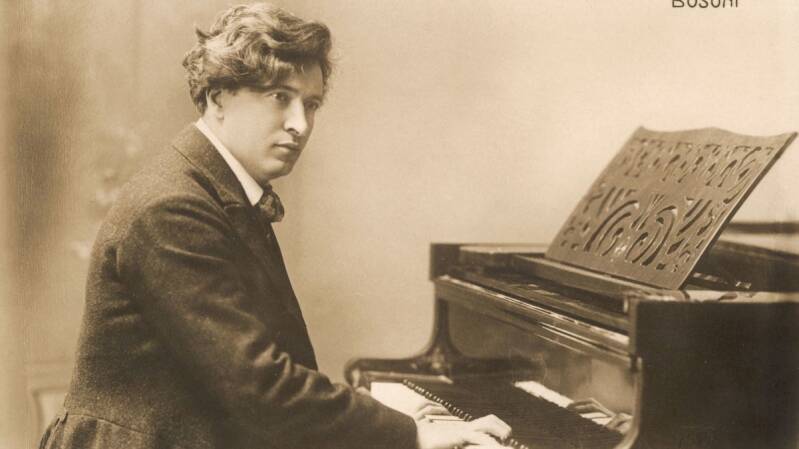
Ferruccio Busoni
born 1 April 1866 in Empoli, near Florence, Italy
died 27 July 1924 in Berlin, Germany
Published:
1916 by Breitkopf & Härtel
CD recording:
2013 by Tanja Becker-Bender
Is it acceptable to transscript a recognised masterpiece of music history? Does the Benedictus from Beethoven’s Missa solemnis lose its spiritual substance when it is adapted into a concert piece for violin and orchestra and its text is omitted? Ferruccio Busoni’s Benedictus (published in 1916, some 100 years after Beethoven’s composition) poses this question.
For Busoni, arrangements were not a loss; on the contrary, they preserved the essential content of a particular piece of music, because the spirit of a piece of music cannot, in any case, be fully captured by any specific form or notation of a particular era.
‘The spirit of a work of art, the measure of feeling, the humanity within it – these remain unchanged in value through changing times; the form that encompassed these three, the means by which they were expressed, and the taste that the era of their creation bestowed upon them—these are transient and rapidly ageing.” (Ferruccio Busoni: “Outline of a New Aesthetics of Music”, p. 4)
What might this mean, specifically, for Busoni’s Benedictus?
In Beethoven’s score of the Benedictus, the Mass chant reaches a heightenedly solemn, ethereal moment when, like a ray of light from above, the solo violin makes its entrance in the Benedictus, together with the flute. In the Mass ritual, the so-called Consecration takes place in parallel with the music – the intense climax of liturgical piety.
Busoni wishes to preserve this spirit of the music—entirely in the spirit of Beethoven, incidentally—beyond the specific liturgy for the secular-religious experience of the individual. That is why he omits all text and choral singing and concentrates entirely on the religious inner life of the individual. The choral lines are replaced by the gentler-sounding string parts; the solo violin, this voice without words, and its pastoral brilliance of triplets comes to the fore, whilst otherwise Busoni retains Beethoven’s instrumentation. At one point towards the end, Busoni makes a substantial abridgement. The Hosanna section, which refers back to the Sanctus, is also logically omitted.
Outside the *Missa solemnis*, the spirit of this *Benedictus* takes on a personal, private quality. Unlike in Beethoven’s version, it no longer addresses the universal human condition, but rather the personal, that which touches one directly. It becomes the inner voice of the religious invocation. The piece bears witness to Busoni’s conviction that transcription becomes a kind of new composition. In this way, a new ray of light is cast in a different manner upon the spirit of the music contained in this work, a spirit that can ultimately never be fully illuminated.
Busoni’s transcriptions repeatedly provoked opposition. To this, Busoni remarked laconically: ‘The original remains, after all.’ One might add: so anyone who has the opportunity to hear a performance of the Missa solemnis should go and listen to it, and all the more so to the original.
Examining this Benedictus by Busoni/Beethoven and the original is particularly relevant at a time when a momentous shift in religiosity is taking place across Western European countries. Depending on one’s perspective, this shift is understood either as a decline, as a process of secularisation, or as a transformation of religious worldviews and religious institutions. For the process of transformation, on the one hand, the traditional substance of the respective historical context must be taken into account. On the other hand, the transience of provisional patterns of thought and institutional forms of organisation must be acknowledged, making way for new creative solutions. Like art, religion too must break new ground, whilst continuing to revere the old and learn from it. Busoni and Beethoven’s Benedictus can rightly trigger a variety of responses. One repeatedly hears something new that can speak to one personally.
Listen here! (approx. 9 mins)
Listening companion:
Busoni takes the prelude (Sostenuto ma non troppo) from Beethoven – which, in Beethoven’s work, bridges the transition from the ‘Osanna’ to the ‘Benedictus’ within the Sanctus – and makes it the opening movement of his arrangement. The orchestra (low woodwinds and strings) plays like an organ, beginning softly, sombrely, expectantly, mysteriously. The dark, artful composition over a chromatically descending bass line finally resolves into long, unusual harmonic sequences: a harmonically tense preparation for what is to come. Advent, so to speak.
Into this dark world, the bright, ethereal blend of a solo violin and a flute unexpectedly shines. Coming from above, the flute and solo violin separate from one another. The solo violin steps forward and leads, in playful syncopated triplets, down and back up through diatonic scales to a uniquely beautiful twelve-eighth pastoral melody that seems to promise the arrival of something new. No words are needed; the violin’s shepherd’s melody has a voice of its own.
A recitative, rhythmic accompaniment in the orchestra also comes to the fore. The woodwinds, however, pick up on the pastoral mood, take over the melody and allow the solo violin new freedom for its luminous, sparkling scales and improvisations, which build towards a first climax in the violin’s solo passage.
Now the soft chorus of string instruments takes over the pastoral melody. As the woodwinds continue the melody, the solo violin also returns and now accompanies the pastoral main melody of the woodwinds and the choral string section with free, virtuosic movement.
As the recitative-like accompanying rhythm re-emerges in the orchestra and the violin rises in virtuoso runs – and then plunges back down – the excitement subsides once more. The solo violin plays soothing triplets to this effect and hovers like a spirit over the waters.
Nevertheless, the recitative rhythm resurfaces in the orchestra and – shortly after shifting to C major – seeks to assert itself against the pastoral melody. After two attempts and violin scales spanning several octaves, the music reaches a fermata climax, sung out by an oboe.
After this climax, Busoni skips over Beethoven’s original score by inserting an Osanna section and moves directly on to the pastoral conclusion of the violin solo. Once again, Busoni faithfully follows Beethoven’s Benedictus conclusion, yet in doing so he highlights the unique message of this Beethovenian violin solo, which he has reinterpreted as a religious voice without words.
Note for music lovers: