Iris ter Schiphorst: AUS LIEBE II (2015) for solo violin and string orchestra, freely adapted from Aria No. 49 from J.S. Bach’s St Matthew Passion (2015)
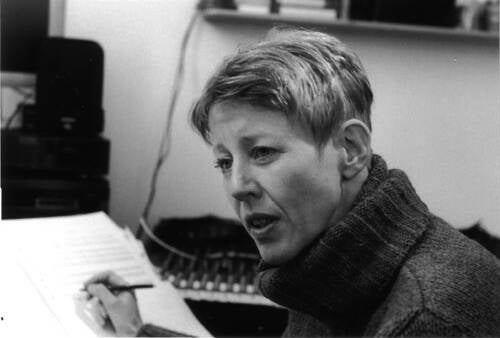
Iris_ter_Schiphorst_by_Christian_Lehmann
Iris ter Schiphorst
born 22 May 1956 in Hamburg, Germany
World premiere:
3 June 2016 in Cottbus, performed by Tobias Feldmann (violin) and the Cottbus Philharmonic Orchestra, conducted by Evan Christ
Recording:
2016 by Tobias Feldmann on Youtube
To get the most out of listening to this contemporary work by the German composer Iris ter Schiphorst, we strongly recommend the following preparatory steps:
1. Read the composer’s notes ‘On Coincidences, Chances and Experiences…’ by Iris ter Schiphorst regarding the original version of this work for string quartet,
Read it here!
2. Listen to Recitative and Aria Nos. 48–49 from J.S. Bach’s St Matthew Passion:
Recitative No. 48
Aria No. 49
3. Read an initial report on the listening experience at the world premiere of the version *Aus Liebe II…* for solo violin and string orchestra by Arno Lücker:
Read it here!
And now, let us openly perceive what, as we listen to *AUS LIEBE II*… , springs forth from this musical collection of ‘coincidences, chance encounters and experiences’ and reaches out to us, the listeners. One’s own engagement with the work can convey a sense of connection between creative-active artistic creation and creative-receptive artistic experience, even if the auditory impressions and the resulting insights will vary entirely from person to person. AUS LIEBE…II gathered the artist’s perceptions, which, as if through a window, let light into her and, through her, gave rise to this work (cf. her description of the work). What this work now reflects back in terms of illuminating light and spiritual content is for the listeners themselves to discover and perceive individually. And this not only during the times of suffering in our world, but especially then.
Listen here! (ca. 10 Min.)
Listening companion
‘Like a flute from far away’ is how it should sound right at the start, when first the solo violin and, shortly afterwards, eight different first violins and eight second violins take turns to weave the most delicate notes in the highest registers. Barely audible in the solo violin is a melody that rises above all the other flute-like sounds.
This is followed by a brief collective pause. The solo violin recites a melody. Yet the delicate tapestry of sound from the high violins continues, often interwoven only briefly with the finest vibrations. Slowly, deeper string sounds blend in as well. Although the solo violin leads the way, it barely stands out from the collective sound. In a delicate, high, resting cadence, all the violins seem to find their place.
But immediately into this conclusion, a loud, scraping noise from the lower strings crashes in. Startle and a brief silence.
From the depths of the basses, a soft, harmonious string sound builds pianissimo. Above this, the solo violin begins an expressive, sorrowful melody on the G string, reminiscent of a Bach aria, which Iris ter Schiphorst titles ‘Das Weinen der M.M. I’ in the score. The solo violin becomes the deeply moving lament of Mary Magdalene and a symbol of profound compassion for the suffering of others. The accompanying string ensemble seems frozen in a fixed sound. Only slowly does the sound break free from this stillness and rise to a forte cry. Silence.
Once more, a chord builds. The violin begins its melody again on the G string, more agitated and now titled ‘The Weeping of M.M. II’. The painful melody of successive semitones is interrupted by the strings, stirring it up. The sounds become glissandi and initial cries. Against this backdrop of mounting drama, the solo violin begins a third ‘Weeping of the M.M. III’, disrupted by dark, jarring pizzicati in the cellos. Deep tremors lead to a fourth ‘Weeping of M.M. IV’. Then, following a final deep tremor in the orchestra, there is a sudden pause on delicate sounds, which, however, grow ever more eerie and finally crash down and fade away with a swelling noise.
As at the beginning, the soft, high-pitched violin solo returns, now described as ‘as if from another world, another time’, flute-like, using harmonics where possible and glissandi in the highest registers. Only the pizzicati throughout the orchestra intrude disruptively – played with a vigorous vibrato. Afterwards, the sound of the violins freezes. Once more, the solo violin presents a fifth, more faintly audible ‘Weeping of M.M. V’; plaintive, unsettling sounds take shape, and interferences arise. Then a sixth, almost desperate ‘Weeping of M.M. VI’, before the disturbances fade away in the dark tones of the two double basses.
Once again, the solo violin begins with its high, soft vision ‘As if from another world, as if from another time, flute-like’ and plunges into an agitated solo. Virtuoso passages in the highest registers are intercepted by plummeting string runs and fierce pizzicatos. As if fleeing, the violin plunges into a kind of virtuoso cadenza. Yet it does not escape; instead, it finds a new rhythm and a way out.
Suddenly, the violin sends out rapid repetitions of notes, which are later taken up by the orchestra. These are also secret messages, like Morse code. The composer has assigned the corresponding letters of the Morse code to the notes: A U S LIEBE… The orchestra takes up these rhythmic messages, whilst the violin rises again, sounding like a flute, ‘as if into another world and another time’. From all the elements of the piece emerges a utopian soundscape that expands through time and is only abruptly cut short at the end, thrown back into this world by a violent scratching sound.
Note for music lovers: