Jean-Baptiste Lully: Petit Motet ‘Regina coeli’ (LWV 77/12) (circa 1685)
Jean Baptiste de Lully
born 28 November 1632 in Florence, Italy
died 22 March 1687 in Paris, France
If one takes a philosophical starting point in a panentheistic conception of reality[i], then engaging with traditional Marian devotion is a way of using feminine-personal symbolism to expand the idea of a ‘Divine in all things’ and to construct it in terms of gender.
Speaking of God repeatedly falls prey to intellectual narrowness and must constantly be broken free from. Poetry (see the Psalms) and sacred music (in the broader sense) serve this purpose, ensuring that religion does not degenerate into dogmatism or systematisation.
[i] This refers to an worldview in the sense of Luke’s Areopagus speech in Acts 17:28: ‘For in him we live and move and have our being, as even some of your own poets have said, “We are his offspring.”’)
As an example of sacred music and poetry, the reception of the medieval ‘Regina coeli laetare’ in the composition by Jean-Baptiste Lully is presented here. The text and a Gregorian melody have been handed down since the 12th century. In the church liturgy, the Regina coeli is sung at the end of Vespers during the central festive period after Easter.
It is little known that Jean-Baptiste Lully, at the court of Louis XIV, not only wrote ballets and operas for the king but also composed church music. The ‘Petit Motet’ Regina coeli could well have been written for a convent. It differs from many of Lully’s magnificent choral motets and operas in its simple, extremely sensitive and expressive style. Whether the setting for three sopranos might also stem from the idea that this is a heavenly angelic song paying homage to the Queen Mary is not far-fetched, though it is not documented. In any case, the notion that Mary is Queen at Christ’s side is an ancient one. The main fresco in the Basilica of Santa Maria Maggiore in Rome depicts a divine couple enthroned in heaven. The divine in the form of a couple is an ancient religious concept. The angelic figures paying homage to this couple also appear in this medieval mosaic (created in 1296 by the Franciscan monk Jacopo Torriti).
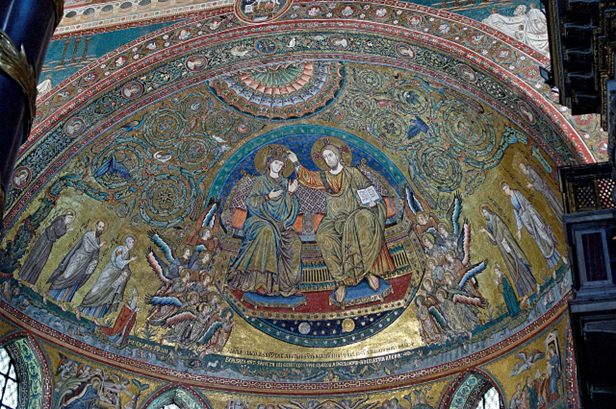
The book that Christ is holding in his hand bears the following inscription in Latin:
“Come, my chosen one, and I will seat you on my throne
[for the King desires your beauty]” (from Psalm 45:11–12).
Listen here! (4½ minutes)
Listening companion:
Music
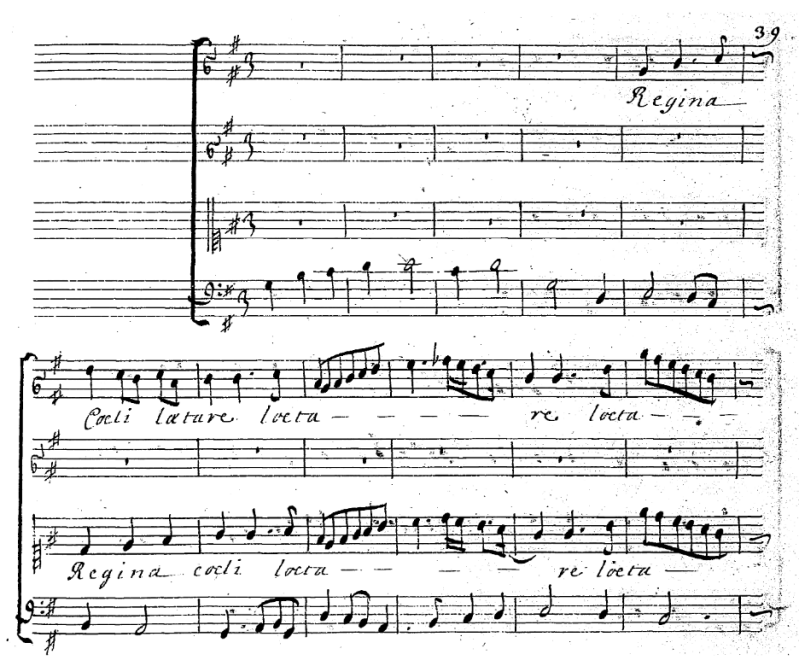
The instrumental basso continuo races ahead in a lively 3/4 time. The first soprano and the third soprano, who follows immediately, call out the Regina coeli with virtuoso coloratura, expressing joy. The Laetare is sung in thirds. This is followed by the second soprano with a variation on the opening theme, to which the other two sopranos respond with a renewed ‘Regina coeli’ entry. All three sing the jubilant Alleluia calls to one another in turn, culminating in a harmonious final cadence.
With a contemplative descent from B to F sharp and a new 4/4 time signature, the second soprano enters melodically, evoking the pregnancy and birth of Jesus. The second soprano repeats the melody a fourth higher, from E to B, and varies it downwards. The third soprano then follows with A to E, leading into G major and further polyphonic Alleluia calls.
With a dotted upward movement, sung first by the sopranos one after the other and then in unison, they evoke, through onomatopoeia, the significance of the resurrection’s hoped-for power to overcome death. The triadic back-and-forth of the Easter Alleluia jubilation, set against a lively basso continuo, seems to go on forever.
The basso continuo, which then resumes with an ascending line, and the entry of the second soprano on the long ‘O--ra’ then lead us back downwards, returning us to the reality of our world. Supplication is the order of the day in the final section of this song. Time and again, the cries of ‘Ora’ bend down imploringly.
Yet the confidence remains. Once again, the third soprano melodiously introduces and sings out the Alleluia motif. The other two sopranos follow. Then the three sopranos recall once more the hopeful, dotted upward movement of the Resurrectio motif, and in the most beautiful three-part polyphony they rush through time towards the end, filled with Easter confidence.
Regina coeli (Latin)
Regina caeli, laetare, alleluia, alleluia.
Quia quem meruisti portare, alleluia, alleluia.
Resurrexit, sicut dixit, alleluia, alleluia.
Ora pro nobis Deum,
alleluia, alleluja.
Queen of Heaven
Queen of Heaven, rejoice, alleluia.
For He whom you did merit to bear, alleluia.
Has risen, as he said, alleluia.
Pray for us to God,
alleluia. alleluia.
Note for music lovers: