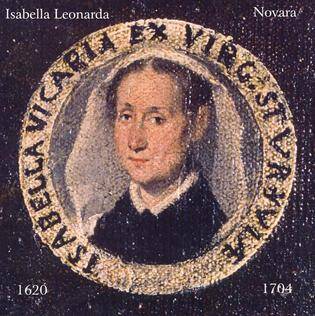
Isabella Leonarda: Motet for two voices with two violins and organ, from Opus 7, Bologna 1677

Isabella Leonarda
Isabella Calegari (maiden name)
baptised 6 September 1620 in Novara, Italy
died 25 February 1704 in Novara

Publication
in: Mottetti op. 7, Bologna 1677

CD recording:
2020: Capella Artemisia, conducted by Candace Smith

Over 200 published works by Isabella Leonarda, an Ursuline nun and Baroque composer from Novara, have survived. In musicology, Isabella Leonarda is regarded as one of the leading figures of the first flowering of women’s compositional creativity to emerge from Italy. However, her work – which is primarily sacred – is still scarcely appreciated as a spiritual testimony, in contrast to that of many male composers, even though she wrote some religious texts herself and then set them to music.
As late as 1591, nuns in an order under the Vicariate General of Novara had been forbidden to play any kind of musical instrument – except the clavichord or the violone da gamba (as bass accompaniment) – and to sing any songs, madrigals or motets of a secular or worldly nature. However strictly the ecclesiastical hierarchy sought to enforce the cloistered life in women’s convents, the Ursuline nuns involved in education were able to evade these restrictions. Isabella Leonarda came from a noble family and – although she had entered the convent at the age of 16 (or 18?) – she probably learnt the basics of music at an early age from the convent’s cathedral choirmaster, Gasparo Casati. Alongside the various leadership roles she held in the convent over the years, she composed – often at night, as she herself writes – both for the convent’s needs and for her publications, and certainly not least for the entertainment of her fellow sisters who were also musicians.
The motet ‘O dulcis sonare’ is taken from her collection Opus 7 and is written for three voices (soprano, contralto, basso), two violins and organ, although the bass part was probably sung in the convent by a female voice – transposed an octave higher. As is clearly evident in this motet, for Isabella Leonarda, singing, dance-like movement (as can be sensed in her frequent ‘Alleluias’) and instrumental music were arguably a higher form of worship than any obedience to ecclesiastical precepts. 

Listen here! (ca. 8 min.)

Listening companion:

To begin with, the three singers celebrate their love of music with a lively three-beat rhythm. Against a continuously progressing basso continuo, the two violins respond in thirds with a short ritornello. The soprano and alto singers then brilliantly perform a concertante passage on the word ‘cantare’.

Following another instrumental interlude of the ritornello, the bass voice – standing out melodically – alludes to the divine delight in music. The instruments, followed by the soprano and the alto, join in.
At the end of this first section, the ‘o dulce sonare’ motif from the beginning is repeated.

Starting afresh, the low voice and the basso continuo, with their ‘Tacete-Cessate’ motif – which draws on the ‘Sonare’ motif – call for a cosmic descent into silence.

The remaining voices insistently take up the ‘Tacete-Cessate’ call; even the instruments join in with beautiful echo effects, but it takes a long time before the call to silence is finally heard.

O dulce sonare, suave cantare


Si note devote sunt Domino care.


Tacete, cessate, o venti importuni,
O aure ingrate, tacete, cessate.

In muto silentio, in dulce quiete

Cessate o venti, o aure tacete.

O sweet sound, o sweet song,


If the devout notes are dear to God.


Be silent, cease, o unwelcome winds,
O ungrateful winds, be silent, cease.

In mute silence, in sweet restfulness,

Cease o winds, breezes be silent.