Olivier Messiaen: *Et exspecto resurrectionem mortuorum* for woodwinds, brass and metal percussion (1964)
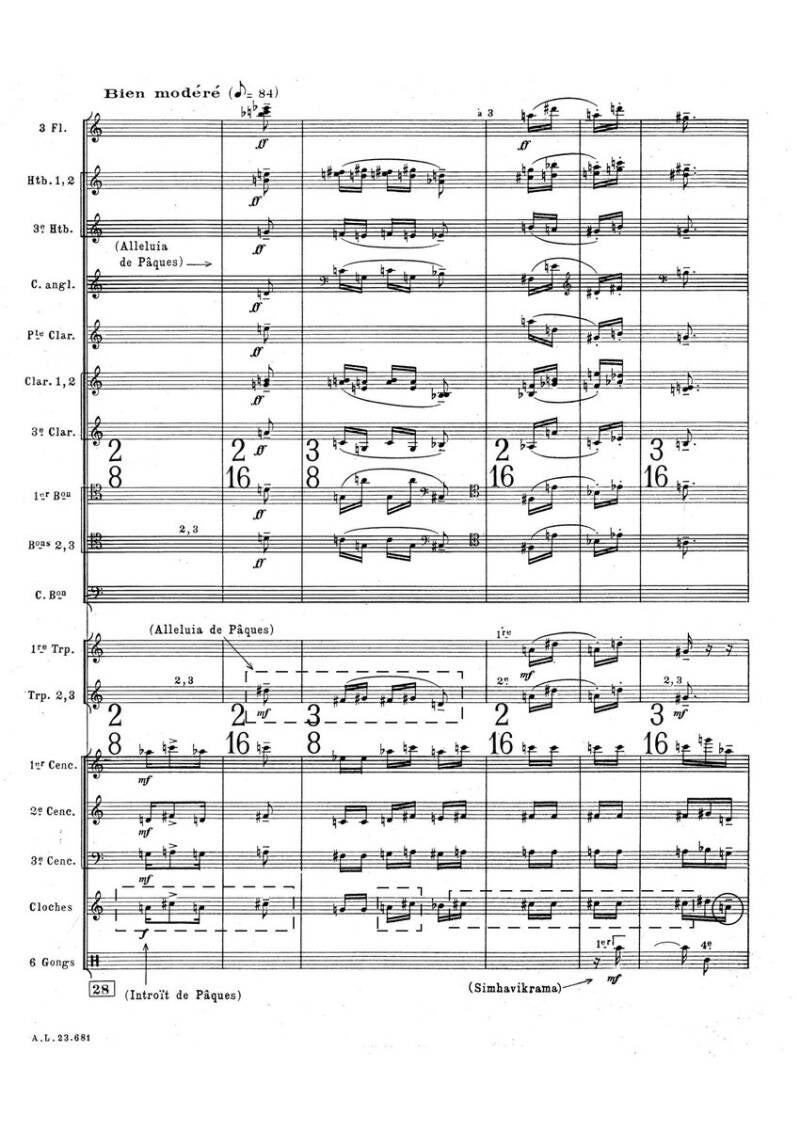
The Easter Alleluia from the fourth movement of the score
Olivier Messiaen
born 10 December 1908 in Avignon, France
died 27 April 1992 in Clichy, Haute-de-Seine, France
World premiere:
7 May 1965 at the Sainte-Chapelle, Paris. Orchestra conducted by Serge Baudo
CD recordings (among others):
1993 Berlin Radio Symphony Orchestra, conducted by Karl Anton Rickenbacher
1995 Cleveland Orchestra, conducted by Pierre Boulez
What awaits us: ecstatic music that seeks to evoke a sense of timelessness within the temporal medium of music. Through his composition and the references drawn from the biblical scriptures, Messiaen symbolically points to a future reality that awaits us all, though it cannot yet be discerned: *Et exspecto resurrectionem mortuorum* (And I await the resurrection of the dead).
The orchestral instrumentation is unusual in itself (consisting solely of woodwinds, brass and metallic percussion), as are the evolving yet static blocks of sound that make up the five movements of this ‘Suite’. Listeners will certainly need to adjust their expectations to this music as the sounds unfold. According to Messiaen, this music is best heard in large Gothic church interiors or outdoors in the high mountains. It was, in fact, premiered at the Sainte-Chapelle in Paris. It was a commissioned work in memory of those who died in the two world wars of the 20th century.
In this ‘Requiem without text’, the five movements are titled with the following biblical quotations, which refer to biblical symbolism surrounding death and the hope of the afterlife. In the original French, Messiaen titled them:
I. «Des profondeurs de l'abîme, je crie vers toi, Seigneur : Seigneur, écoute ma voix !» (Psaume 130, v.1 et 2)
II. «Le Christ, ressuscité des morts, ne meurt plus; la mort n'a plus sur lui d'empire.» (saint Paul, Epître aux Romains, chap.6, v.9)
III. « L'heure vient où les morts entendront la voix du Fils de Dieu...» (Evangile selon saint Jean, chap.5, v.25)
IV. «Ils ressusciteront, glorieux, avec un nom nouveau - dans le concert joyeux des étoiles et les acclamations des fils du ciel.» (saint Paul, 1er Epître aux Corinthiens, chap.15, v.43 - Apocalypse de Saint-Jean, chap.2,v.17 - Livre de Job, chap 38, v.7)
V. « Et j'entendis la voix d'une foule immense...» (Apocalypse de saint Jean, chap.19, v.6)
Listening tip: To fully appreciate the ecstatic quality of the sounds intended in this piece of music, it is advisable to wear a good pair of headphones (unless you have the chance to hear the piece live in a church, or even outdoors, or in a high-quality recording studio).
Listen here! (25 mins)
Listening companion:
I. ‘From the depths I cry out to you, God: My God, please hear my voice!’ (Psalm 130:1–2)
This desperate cry of prayer inspired Messiaen to compose a series of sombre blocks of sound that get right under your skin. The movement is in three parts. Right at the start, the brass section plays in unison in octaves what Messiaen called the ‘Thème de la profondeur’ (Theme of Depth), a melody consisting of seven notes, which is immediately repeated – with the woodwinds joining in – and then concluded with the same instrumentation as at the beginning (and with the tam-tam).
Messiaen titles the second section ‘Harmonisation’. The seven-note block melody is given a polyphonic texture, but gradually fades into a varied sequence of sounds in which the sound blocks – never identical, yet similar – are repeated.
Finally, the abbreviated, monophonic opening melody (with tam-tam) leads into the outburst of the third section, which Messiaen calls ‘cri de l’Abîme’ (Cry from the Abyss). This cry consists solely of long, dissonant blocks of sound, intensified to fortissimo, which are reinforced by metallic percussion and cry out for salvation.
II. ‘Christ, having been raised from the dead, dies no more; death no longer has power over him.’ (Romans 6:9)
To begin with, the woodwinds play a short melodic phrase that ends on a long-held E. In response, the horns (with a slight accompaniment from the woodwinds) play a chord consisting of the same notes as in the melody. This is immediately resolved in the form of a ‘mélodie par manques’, that is to say, the end of each horn note is emphasised in turn. Taken together, these final notes form the same sequence of notes as the opening melodic phrase.
This mysterious opening is followed by a second section: first the oboe alone, then the clarinet, playing the same notes as at the beginning, but now as a melody that is about ten times slower and sung out. After a brief conclusion to the melody, the flute also takes up the melody as a solo; the oboe repeats a slight variation of this lyrical melody on its own once more; the flute and clarinet continue the melody, and at the end the English horn joins in briefly. A repetition of the same, but always slightly different.
In a third section, the Mexican cencerros, bells and gongs introduce a new rhythm. Messiaen explains: ‘This is the Samhavikrama rhythm (the power of the lion’s rhythm) … It is dedicated to Shiva, because of its 15 mâtras (3 times 5), and Shiva represents the death of death. All these symbols, strung together, can signify victory over death.’
Once this ancient Vedic rhythm has been introduced, it recedes into the second cencerro, masked by the complex tonal rhythms of the woodwinds, whilst above all the sounds and rhythms the trumpet plays its own brilliant, luminous melody (‘a little like Matthias Grünewald’s Resurrected Christ, who seems to float away in a rainbow of his own light’, as Messiaen explains in the score).
This section is followed once more by the slow section, featuring the oboe, clarinet, English horn and flute, slightly varied in tone, and above all complemented by a pianissimo gong counterpoint: once again a repetition of the same and yet not the same: timelessness, depicted in time!
This section is followed by a repetition of the rhythmic section featuring the triumphant Samhavikrama rhythm. Once again, the trumpet shines discreetly from within the rainbow of woodwind colours, celebrating victory over death.
After a brief pause, the opening melodic phrase returns, followed by the responding horn chord, the ‘mélodie par manques’ and a flute-and-clarinet coda.
After a long pause, the clarinet, alone and unaccompanied, reopens the slow, melodious section with the ever-recurring, yet slightly altered and never quite predictable sequence of notes, finally leaving three notes to the flute and four to the English horn, which allows its final note to linger for a long time.
III. ‘The hour is coming when the dead will hear the voice of the Son of God…’ (John 5:25)
Once again, Messiaen explains his interpretation of the biblical promise in the score: ‘This voice symbolises the signal of the Resurrection: a divine command whose execution is immediate, just like the power of grace in the sacraments. It is symbolised here once more in three ways’ (Messiaen).
Right at the start of this movement, this voice is imitated in the woodwinds as the threefold call of a bird which, according to legend, is said to be heard in Latin American indigenous cultures at the moment of death. It is the Uirapuru, a ‘famous bird: the musical jewel of the Amazon region … Its mysterious, flute-like song, with its magical timbre, surprises and enchants the listener with its highly erratic melodic leaps, its changes in timbre and its richly contrasting dynamics’ (Messiaen).
No sooner have the birdcalls faded than the death bells ring out into the silence. The sequence of their tolls conveys an overall impression of a downward movement.
This is followed by a crescendoing outburst from the entire orchestra, which, according to Messiaen, symbolises the terrified awakening of the dead.
This awakening is followed by a glimpse into the abyss of death: just four low notes in the basses, a tritone upwards, a tritone downwards, with the same notes moving in reverse as the bells did before.
Immediately afterwards, tam-tam rolls and gong strikes build in volume to a repeated fortissimo, allowing the resonance to linger for a long time. It is the sound itself, the pure structure of growth and decay.
The call of the Uirapura bird returns, the same, and yet barely recognisably different. Every death is death, yet different. Messiaen used to transcribe birdcalls into musical notation whilst observing nature, and would then vary them for his compositions.
Once again, the bells join in, mirroring the first part of the movement, now in a balanced flow of sound.
Again, a terrifying orchestral outburst of all the wind and percussion instruments ensues in a subtly altered orchestration. Only the subsequent glimpse into the abyss of death remains the same even upon its repetition: an ascending tritone, a descending tritone. The conclusion of this sequence of interconnected death-symbolic events is the loud and powerfully long tam-tam bell sound, identical to the first: a cycle of growth and decay.
IV. “They will rise again in glory, with a new name—in the joyful concert of the stars and amid the jubilant applause of the children of heaven.” (Paul, 1 Corinthians 15:43; Revelation 2:17; Job 38:7)
The symbolism of the number 3 in this movement refers to the Christian concept of the Trinity, to God as the primal force and dynamic of the Resurrection.
Three long, mysterious tam-tam strokes in pianissimo are followed by an Easter hymn sung by the entire orchestra, which is heard three times in this movement. This Easter hymn quotes the Gregorian Easter Introit "Resurrexi, et adhuc tecum sum, alleluia" (I am risen, and am now with you, Alleluia) in the Cencerros.
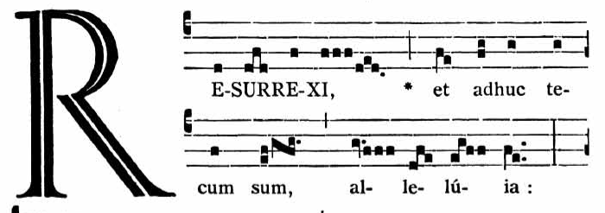
Above this, the trumpets follow, adorned with a chordal "halo" from the woodwinds, and play the Easter Alleluia.
Then the three long, mysterious tam-tam strokes of the beginning interrupt the Easter hymn, now somewhat louder in piano.
Into this almost cosmic echo, a bird jubilantly sings: the Calandrian lark, a Spanish-Greek lark whose song, according to Messiaen, is characterized "by a great rhythmic variety, a fast tempo, a very multifaceted timbre, and a continuous cheer-fulness." Its song is echoed by flutes, oboes, clarinets, and bassoons, symbolizing joy and agility. Messiaen plays with rhythmic permutations and constant changes of meter, thereby achieving an impressive outpouring of Easter joy.
Once again, three forceful tam-tam strokes interrupt, this time in forte.
But the Easter praise continues liturgically, with the Centerros once again entering with the Resurrexi motif. The Easter Alleluia, harmonized with Messiaen's "holy radiance" chords, also resounds again. Additionally, the six gongs quote the Samhavikrama rhythm.
Again, the three long tam-tam strokes abruptly interrupt the musical praise, now in full fortissimo, with a powerful, reverberating resonance.
The Calandrian Lark follows with its rhythmic and joyful song, singing as if it could not stop, prolonging its jubilation…
…until the long tam-tam strokes abruptly strike again in triple fortissimo, spreading tremendously far and wide.
For the third time, the Risen Ones intone the Easter praise: the Easter Introit "Resurrexi" and the Alleluia. Yet the Vedic Samhavikram rhythm also subtly resonates in the six gongs. The theme of the first movement is newly introduced in the horns, trombones, and saxophone, a reminder of the abyss of the deep amidst the praise. In this way, Messiaen artfully combines all the themes, harmonic nuances, and sonic complexes, layering them upon one another to suggest eternity in all its diversity. "The angels and the stars unite to praise the resurrected in their glory" (Messiaen). The section does not end abruptly, but this time with an extended, silent fermata.
Everything culminates in a final section that begins mysteriously quietly with tam-tam beats and their undamped resonances (now supplemented by additional soft gong sounds), and then repeats these three times forte.
The entire resurrection process, however, ends by gradually progressing forward – yet statically – to a maximum final fortissimo of long, striding chords from the entire orchestra.
V. “Then I heard what sounded like the shout of a great multitude and like the sound of mighty waters…” (Rev. 19:6)
Messiaen himself explains: “Like the roar of mighty torrents: this is how the hymn of praise of the saints in the Book of Revelation is described as a solemn force. The repeated strokes of the gongs, the low brass, and the full orchestra are characterized by this choral effect: a tremendous fortissimo, unanimous and simple.” While the regular gong strokes—accompanied by soft bells—constantly vary in time signature between 2/8, 4/8, and 6/8, symbolizing the march of the many resurrected, the horns and trumpets begin with a very slow melody that starts with a tritone. This static brass melody is harmonically enriched by the additional entry of the woodwinds. Then the horns and brass begin their melody again with the tritone, and once more the woodwinds add new timbres to the melodic chords. A third time, the brass begin alone with their tritone and their melody. Once again, the entire orchestra joins in with all its ecstatic colors, building step by step to an ultimate fortissimo, then breaks off, leaving back all those who had been swept away by this ecstatic progression - abruptly and deeply moved.
Note for music lovers: