Ernest Bloch: Nigun, from the suite ‘Baal Shem’, for violin and piano (1923)

Ernest Bloch
born 24 July 1880 in Geneva (Switzerland)
died 15 July 1959 in Portland, Oregon (USA)

Premiere:
6 February 1924 by the violinist André de Ribaupierre in Cleveland (Ohio)

Recordings (among many others)
1972 Jascha Heifetz
1990 Ivry Gitlis
2006 Vadim Gluzman
2009 Ida Haendel

Although sacred music (and European music in general) is strongly influenced by European Christianity, various Jewish traditions have also influenced outstanding compositions of a sacred nature.

The Swiss composer Ernest Bloch, who was raised in a Jewish household, demonstrated the passionate expressiveness this can achieve in musical language in his 1923 composition ‘Nigun’. In doing so, he draws on the Hasidic singing tradition and makes a striking reference to this kind of ecstatically committed religiosity. Nigun refers to an improvised melody with repetitive sounds. It is a Hasidic style of singing which uses no words, merely vowels such as lay lay lay… ay ay ay etc., to express the incomprehensible presence of the name of the One who concerns us most deeply.

Ernest Bloch himself wrote of his compositions on Jewish themes:

“It is neither my intention nor my desire to attempt a reconstruction of Jewish music or to base my work on more or less authentic melodies; for me, it is important to write good and sincere music. What interests me is the Jewish soul, that enigmatic, passionate, restless soul which I sense resonating throughout the Bible; I try to hear all of this within myself and to convey it in my music, that venerable emotion of the people which slumbers deep within our souls.”

‘Nigun’ is the middle movement of a three-part suite for violin and piano (later orchestrated by Ernest Bloch himself), which he called ‘Baal Shem’. With this title, he refers to the Hasidic healer and Rabbi Israel ben Eliezer, known as Baʿal Shem Tov (בעל שם טוב), ‘owner of the good name’, colloquially abbreviated to BeSchT), born in 1700, died in 1760 in Podolia, Poland-Lithuania. A pan-theistic worldview shaped his optimistic view of humanity. Despite his great erudition, he confessed: ‘Everything I have achieved, I have not achieved through study, but through prayer. ’
Nigun can therefore be understood and heard as a silent prayer inspired by the Hasidic Jewish tradition. Bloch also composed Nigun as a very personal tribute to his mother.

Listen here! (6’40 min.)

Listening companion:

The piano accompaniment in *Nigun* begins with a dotted upbeat motif that recurs throughout the composition. A G minor chord is heard. Against the tremolo of the piano bass, the violin then rises plaintively (‘lamentoso’) with its modal melody, inspired by Jewish chants. The violin was not chosen as the main instrument by chance, as it perfectly imitates the human voice of the Hasidic cantor, oscillating between lament, joy and prayer.
The melody moves in triplets, initially firmly grounded on low notes, then slowly striving upwards. Through abrupt changes of rhythm and interruptions, it reaches higher registers. Intensifying double stops lead to a first melodic climax, which begins with the opening motif. The violin sings its melody passionately. It builds rhapsodically into free, cadential improvisations and draws the piano accompaniment into the melody. In the piano’s bass accompaniment, rolling rhythmic figures emerge, which can be interpreted as the lead singer’s ritualised body movements (known as ‘shuckling’).
Over this, in a new section, the violin repeats its expressive prayer and melody in the form of an imitation, creating an echo effect and lending the music greater depth. The opening motif in the piano once again challenges the violin to move upwards in free violinistic figurations and to play freely in the highest register over the piano’s ecstatic glissandi.

A cadential transition by the violin then leads into the middle section of the Nigun. At a slightly faster tempo, the imagined lead singer slips into a kind of recitative-like melodic line, rendered by the violin in an imitative and rhythmically halting manner.
In a long, sweeping, searching upward movement, the lead singer rises to the highest register and into a new ecstasy, supported by the piano fortissimo. Soon, despite the use of double stops, a certain exhaustion and strain on the music’s power sets in. The dynamics subside.
The violin attempts to regain ground. In a free passage that culminates in the oscillation of two notes, it finds its way back, as a transition, to the G minor of its opening melody. The violin plays its main melody an octave higher than at the beginning. Once again, the opening motif and triplets can be heard in the background. This final section is a repetition of the beginning, yet with passages that highlight the violin’s skill and virtuosity. Like the Hasidic worshipper who has experienced the proximity of transcendence, the violin returns to everyday reality strengthened and full of goodwill. This section ends contemplatively in a coda characterised, as at the beginning, by modal harmony. Three times the violin presents a melodic gesture, each time an octave higher, and ends calmly on a natural overtone on the note D, played on the G string of the violin.
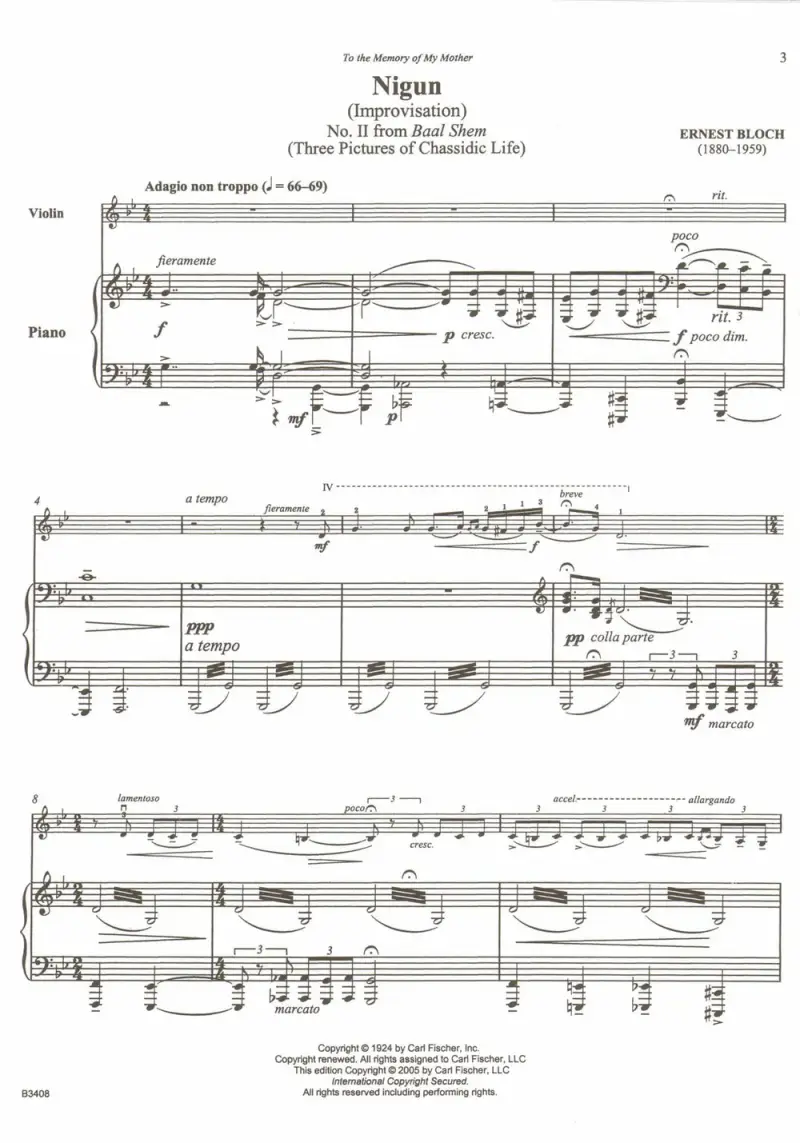
The way in which this entire meditative process is shaped can be interpreted quite differently by the musicians at every performance. The greatest violinists have explored the nigun, on multiple occasions and in various recordings. To conclude, we would like to draw your attention to four interpretations, which can be heard here:

Jascha Heifetz: outstanding violin playing

Ivry Gitlis: existential

Ida Haendel: deeply internalised

Vadim Gluzman: expressive and resonant