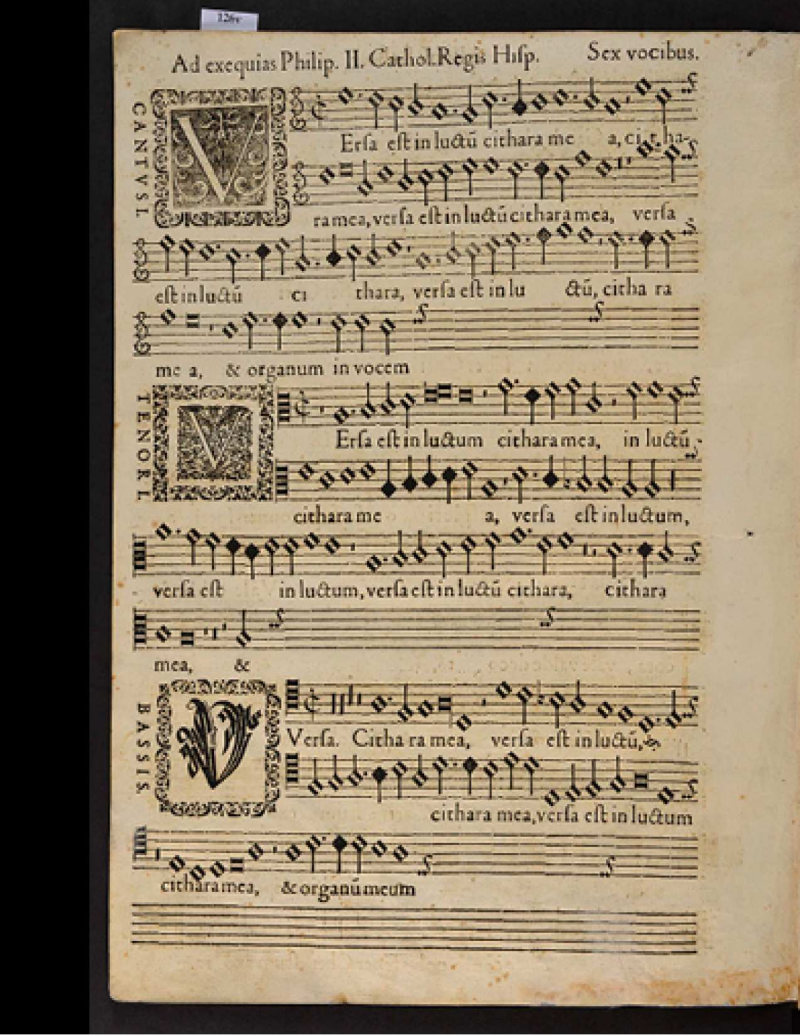
The upper voice of Cantus I begins to sing alone. In a poignant, slow downward movement, it fills the space; the grief draws us down, as it were.
But almost simultaneously, Tenor I responds with a counter-movement of the same melody, moving upwards. Gradually entering in canon, Cantus II and Tenor II repeat this antagonism. A mood of mourning emerges from the interplay of these four counter-movements. The ‘cithara’ mentioned in the text becomes, in song, an instrument of lament. The ‘mea’ is sung out painfully and broadly. The voices communicate with one another through jarring dissonances. The beauty of the melodious downward movement stands out repeatedly against the harmonic reservations. The flow of sounds finally comes to a halt in a first, longer cadence, as it were, to catch one’s breath.
The Tenor II then introduces a second musical section. With its newly introduced melodic line ‘et organum meum’, the organum, too, begins to lament and mourn. The polyphony becomes denser; one can clearly hear the weeping of many individual voices (at ‘vocem flentium’), the order is disrupted by the voices crossing over one another, and the music becomes more dramatic…
… and from the midst of all this polyphonic spatial music, the ‘Parce’ (Spare me!) emerges from the individual voices. The lament becomes a prayer: ‘Parce mihi Domine’. The ‘Domine’ is harmonised in a new, hopeful way. What remains is empty trust: ‘Nihil enim sunt dies mei’. Even the music now becomes more subdued, more humble. The notes end in a final cadence, looking upwards with trust and offering comfort.