Dieterich Buxtehude (1637–1707): Cantata ‘Herr, wenn ich nur dich hab’ BuxWV 38 (c. 1668)
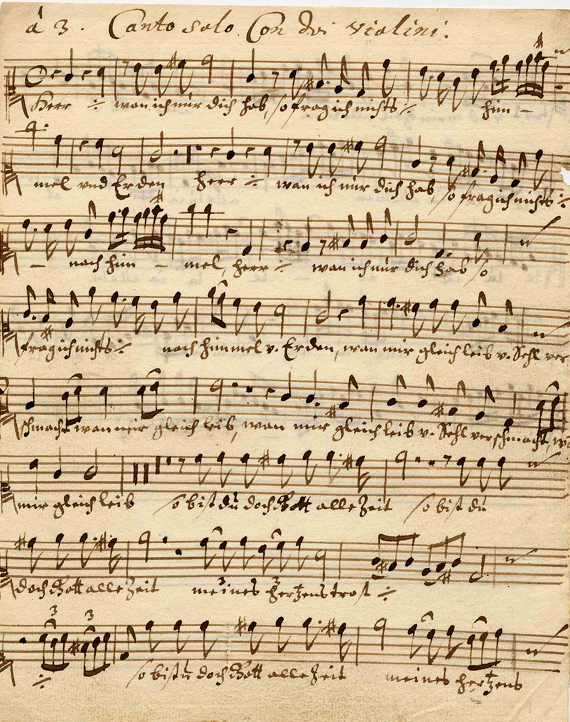
A copy by Gustaf Düben from 1680
Dieterich Buxtehude
born probably around 1637 in Helsingborg (then part of Denmark, now Sweden)
died 9 May 1707 in Lübeck (Germany)
Composition and source:
This cantata by Buxtehude, BuxWV 38, is found in the Düben collection (1680), but is thought to have been composed as early as 1668.
Text source:
Psalm 73:25–26
Various recordings, amongst others:
1997 Emma Kirkby (soprano), with John Holloway and Manfredo Kraemer (baroque violins)
2013 Laura Heimes and Voices of Music, live recording on YouTube
2018 Margret Bahr and Neues Barockduo Berlin
At St Mary’s Church in Lübeck, only two verses from the biblical Psalm 73 were selected for one of their evening concerts; these verses sound quite pious. However, the social context of Psalm 73 is omitted – the depiction of a divided world of the super-rich and the poor, the powerful and the powerless: ‘Their eyes are so full of fat they can scarcely see, / their hearts overflow with wicked schemes. / They scoff and speak evil, / they speak of oppression from on high. / They open their mouths wide to the heavens / and give free rein to their tongues on earth. / That is why the people turn to them.’
The psalmist, however, ‘pondered to understand this’. And only then, in the two selected verses, does he arrive at the conclusion as to what truly makes sense in the face of the powerlessness and cynicism of this situation. These lines, which must actually be read within the social context of the time, form the text of this cantata, BuxWV 38, by Dietrich Buxtehude.
From 1668 to 1707, Dietrich Buxtehude organised the so-called ‘Abendmusiken’ (evening concerts) at St Mary’s in Lübeck, an early form of concert series in the tradition he had inherited from his predecessor, Franz Tunder. The fact that the controversial verses of Psalm 73 were omitted is likely due to the fact that the ‘Abendmusiken’ were organised and funded by Lübeck’s wealthy merchant class, and the full psalm would not have gone down well there.
Nevertheless, Buxtehude did not compose this cantata in an elaborate or pompous style, but chose only modest means for its musical realisation: a soprano voice, two violins and the organ (or a basso continuo ensemble). The chaconne structure is fascinating: the same bass figure is repeated 24 times (a coincidence, or a reference to 24 hours – meaning it applies throughout the day?) within 73 bars (again, a coincidence, or a numerical allusion to the entire Psalm 73?). In this way, with the most minimal musical means, a profound message is conveyed that remains relevant even today, including within our social context.
Listen here (approx. 5 mins)!
Listening companion:
Music
The basso continuo begins on G; immediately, the soprano enters an octave higher with the cry ‘Lord’, also on G. And straight away the bass descends to F sharp, whilst the soprano calls out to the Lord a second time, rhythmically offset, ascending to A. This ascending, prayerful movement from the soprano – ‘if only I have you’ – is contrasted by the steady bass chaconne melody: G–F sharp–E–B–C–D.
As the chaconne melody begins anew for the second time, the soprano asks, ‘so I ask for nothing, so I ask for nothing of heaven and earth’, with a beautiful, catchy ornament on the word ‘heaven’.
When the bass chaconne resumes for the third time, the first violin imitates the soprano melody. The second violin follows in canon a fourth lower. The two violins finally converge in rhythmically staccato figures.
Then, over the chaconne bass, the soprano enters once more with the same melody as at the beginning, again deliberately emphasising ‘Dich’ and ‘Himmel’ as it ascends. This time, the violins accompany the soprano with their figures; the soprano then repeats the second violin’s canon a fourth lower. All three voices unfold over the bass, which returns reliably time and again, and densify the initial musical material right up to ‘Erden’.
Text (german)
Herr, wenn ich nur dich hab,
so frag ich nichts, so frag ich nichts
nach Himmel und Erden.
Text (english)
Lord, if I have only you,
I ask for nothing, I ask for nothing
beyond heaven and earth.
Left alone by the violins, the soprano sings a new, poignant D–C sharp melodic figure: ‘Wenn mir gleich Leib…’. This is about matters of the deepest significance. The two violins follow like shadows, initially with the same melodic figure, but then extend their emotional turmoil with smaller motifs, imitations and sixteenth-note runs – always over the constantly present chaconne melody.
Wenn mir gleich Leib und Seel verschmacht,
Even if my body and soul were to wither away at this very moment,