Giuseppe Verdi: Offertorio ‘Domine Jesu Christi’, from: Messa da Requiem (1874)
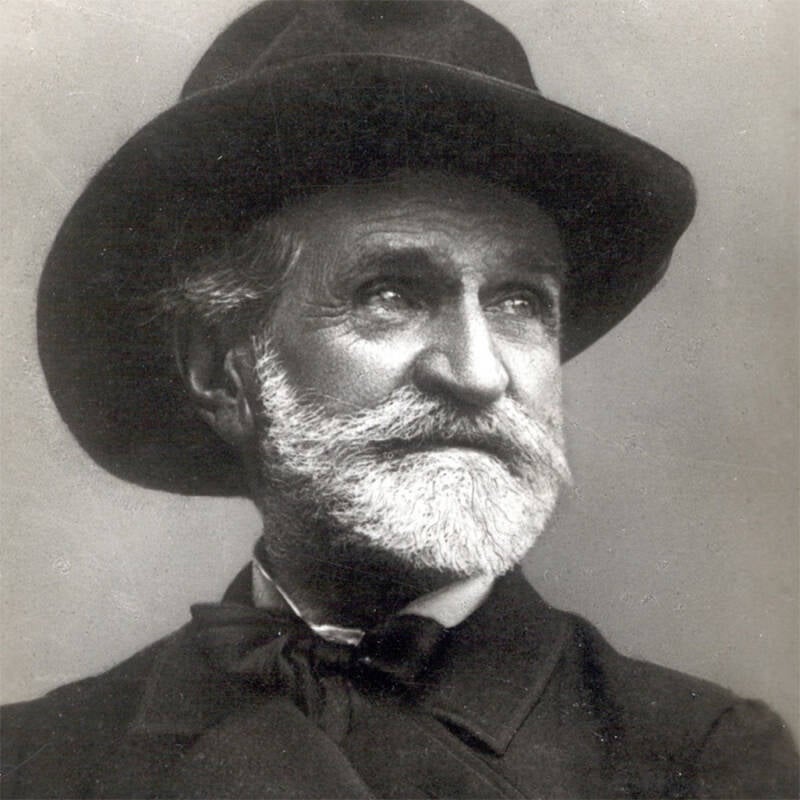
Giuseppe Verdi
born 9 or 10 October 1813 in Le Roncole, Italy
died 27 January 1901 in Milan, Italy
Premiere of the *Messa da requiem*:
22 May 1874 in Milan
Recording (among many others):
featuring Maria Stader, Marianna Radev, Helmut Krebs and Kim Borg
RIAS Symphony Orchestra Berlin,
RIAS Chamber Choir and the Choir of St Hedwig’s Cathedral, Berlin
Ferenc Fricsay, conductor
The death of the Italian national poet Alessandro Manzoni (22 May 1873) affected Verdi so deeply that he resolved to expand his ‘Libera me’ – which he had already contributed to Rossini’s memorial service – into a full-scale Requiem. On the anniversary of Manzoni’s death, on 22 May 1874, Verdi conducted the world premiere of his Requiem for four solo voices, choir and orchestra in Milan.
Speaking later about Manzoni’s novel *I promessi sposi* (The Betrothed), which Verdi had first read at the age of 16, he said:
‘My enthusiasm for this book remains undiminished: indeed, as my understanding of human nature has deepened, it has grown even further. And this is because this book is “true”, as true as “Truth” itself. Oh, if only artists could one day grasp this truth, there would be no more musicians of the future or the past; no veristic, realistic or idealistic painters; no classical or romantic poets; but only true, true painters, true musicians’
For Verdi, truth was existentially linked to life and death. That is why he portrayed truth in his operas. ‘Recreating the truth may be good, but inventing the truth is better, much better.’
It was not only in his operas, but also in his *Messa da Requiem*, that he was concerned with the true. His own fate may have played a part in this. Verdi lost his only sister, Giuseppa Francesca (1833), who may have been disabled, whilst he was still in his twenties. His only two children also lived to be just one year old: his daughter Virginia Verdi died in 1838, and his son Ilicio Verdi in 1839. The blow that hit the 27-year-old Verdi hardest came when, after four years of marriage, his wife Margherita, née Barezza, also died of meningitis at the young age of 26.
The horror of death therefore takes centre stage in the main sections of his *Missa da requiem*. As in many of his operas, death and the fear and gloom associated with it are a recurring theme. The horror of the Day of Wrath, the ‘Dies irae’ – the second part of the Requiem – is composed in a particularly magnificent and operatic style. What follows in the third section, the ‘Offertorio’, is the focus of interest here. What does Verdi set against death, compositionally speaking, following the most terrifying and sombre section of the Requiem? Verdi adopts the ancient liturgical texts of the Offertory – the procession of the gifts at funeral services – and integrates them into his work.
Liturgically, the Offertory is one of the specific sections of a funeral Mass, which originally accompanied the procession of the faithful bearing the offerings. The text of the Offertorium dates from the early Middle Ages and draws on ancient concepts (e.g. ‘de ore leonis’, ‘Tartarus’); it is considerably older than the ‘Dies irae’, which was not composed until the 13th century and was only incorporated into the funeral Mass in the 15th–16th centuries (having been definitively legitimised by the Council of Trent).
Images evoking the threat of death include poenae inferni (underworld punishments); profundus lacus (deep abyss); ore leonis (the lion’s wrath); Tartarus (the underworld); and obscurum (darkness). From these, the King of Glory—that is, Jesus, who rose from the dead as the Christ—sets them free. The souls of the departed are accompanied by Michael, the messenger of God, who leads them into the light. In the procession, the faithful accompany the dead into the light and towards the promise once made by God to the first believer, Abraham. At the conclusion of this ancient symbolic vision of hope stands the prayer: may the Lord of the new world, Jesus the Christ, grant the departed passage from death into life.
Whilst fear and accountability take centre stage in Verdi’s ‘Dies Irae’ (Part 2), in the Offertorio (Part 3) Verdi finds new tones for a liberating and promising transition from death to life.
Listen here:
Offertorio (approx. 9 mins)
Listening companion:
Part III: Offertorio – Solo Quartet
The Offertory begins with a cantilena from the cellos, to which the woodwinds respond first, followed by the quartet of solo voices. The choir remains silent during the Offertory; liturgically speaking, the members of the congregation are making their way to the altar. The prayer is performed by the orchestra and soloists.
The bass begins in a lyrical 6/8 time with a plea for the deceased to be freed from all the hardships that, according to our understanding, being dead might entail. Comfort and introspection (with strings and woodwinds) are set against the preceding ‘Dies irae’ (with trumpets and trombones).
The musical highlight is the solo soprano’s high E, which radiates light (high, shimmering violin notes) into the darkness of death and places its trust in God’s guidance (the divine messenger ‘Michael’) in the face of death.
This personal consolation is reinforced by ancient religious promises: the quartet of solo voices sings ‘Quam olim Abrahae’ with insistence and almost a sense of demand.
This jubilant recollection fades away – growing quieter – into prayer and leads into the middle section of the Offertorium.
As if on a sound-island above the tremolos of the strings, the solo tenor sings with deep feeling and simplicity. Gently and humbly, he offers prayers and supplications for those who have recently passed away. The bass and sopranos join in.
Once again, the tenor takes centre stage, this time with the existentially crucial plea to lead the departed from death into life.
And, as before, this prayer of hope is supported by traditional and biblical evidence in the form of the ‘Quam olim Abrahae’, which begins like a fugue.
The piece concludes, however, with a repetition of the opening melody – namely, the plea for deliverance from punishment – which culminates in an ascending vocal cadence on ‘Fac eas de mortis transire ad vitam’. The opening melody fades away, transfigured, in the clarinet and ‘morendo’ (as notated in the score!) amidst the soft sound of the strings.
Offertorio
Domine Jesu Christe, rex gloriae,
libera animas omnium fidelium
defunctorum de poenis inferni
et de profundo lacu.
Libera eas de ore leonis,
ne absorbeat eas tartarus,
ne cadant in obscurum;
sed signifer sanctus Michael
repraesentet eas in lucem sanctam,
quam olim Abrahae promisisti,
et semini eius.
Hostias et preces tibi,
Domine laudis offerimus.
Tu suscipe pro animabus illis,
quarum hodie memoriam facimus;
fac eas, Domine, de morte transire ad vitam,
quam olim Abrahae promisisti,
et semini eius.
Libera animas omnium fidelium defunctorum de poenis inferni,
fac eas de morte transire ad vitam.
Offertorio
Lord Jesus Christ, King of Glory,
deliver the souls of all the faithful
departed from the pains of hell
and from the bottomless pit.
Deliver them from the jaws of the lion,
that hell may not swallow them up,
and they may not fall into darkness;
but may the holy standard-bearer Michael
bring them into the holy light,
as Thou didst promise of old to
Abraham and his seed.
We offer unto Thee, O Lord,
sacrifices and prayers of praise.
Do Thou receive them on behalf of those souls
whom we commemorate this day.
Allow them, Lord, to pass from death to life,
as Thou didst promise of old to
Abraham and his seed.
Deliver the souls of all the faithful dead from the
pains of hell;
Grant that they might pass from death into that life.
Note for music lovers: